
The Sentence I Keep Hearing in Different Rooms
A Bay Area therapist told NPR earlier this spring that one of her clients described AI anxiety this way: “It is like waiting for a sentence that cannot be appealed.” That stayed with me. Not because of the AI part. Because of the waiting part.
The waiting is the thing.
I am hearing the same sentence in different vocabularies all week. The leader scanning Slack for a cut that has not been announced. The parent watching their teenager’s mood the way some people watch a stock ticker. The couple who has not fought in six months and somehow that is the problem. The dispatcher who knows what the next call is going to feel like before it arrives. The trauma survivor who has not been hurt in two years and is still standing in the doorway, listening.
The threat does not have to land for the body to keep running the program.
What the Body Actually Does With Uncertainty
Most people I work with have already tried the obvious things. They have read the books. They have meditated. They have exercised. They have done the breathwork apps and the cold plunges and the sober month. The advice is real and the techniques are useful, and there is a place underneath all of it where none of it quite reaches.
That place is the nervous system itself.
The body has two kinds of threat response. There is the phasic kind. Something is happening right now, you react, you recover. And there is the sustained kind. Something might happen, you do not know when, and your nervous system holds the alarm in a kind of background hum that never fully resets. The neuroscience literature on this is consistent. The amygdala handles the sharp, fast threat. A related structure called the bed nucleus of the stria terminalis handles the slow, ambiguous kind. The slow, ambiguous kind is what most of my high-functioning clients are living in.
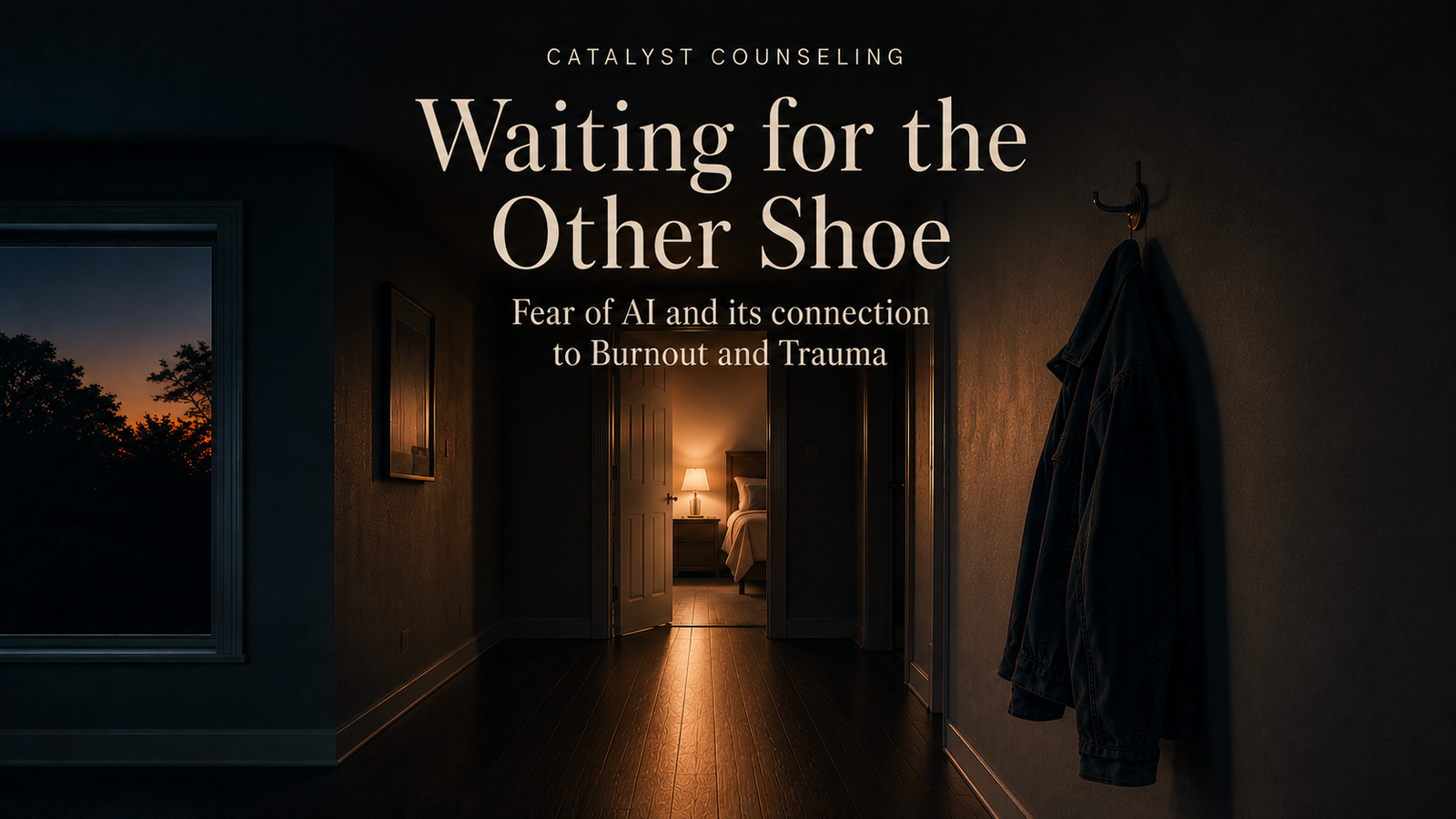
This is the part that explains why a perfectly competent, well-loved, well-employed person can describe their life as “fine” and feel, in their body, like they are standing in a hallway at 3 a.m. listening for footsteps.
Right now the air is full of unresolved threats that do not promise to resolve. Mental Health Awareness Week opened on May 11 with business leaders bluntly calling burnout a structural risk rather than a vibes problem. A national survey from the Kids Mental Health Foundation found that 97 percent of parents reported stress related to parenting in the past month, with kids’ mental health and behavior cited among the top reasons. AI is moving fast enough that some therapists report 80 percent of their clients work in or around it, and the question they keep bringing in is some version of “Am I about to be obsolete?”
These are not separate trends. They are the same trend in different rooms. The shape of the threat is slow, ambiguous, not currently happening, capable of happening soon. That shape keeps the body in a state of low-grade preparedness for years.
The cost is invisible from the outside. People in this state continue to show up. They run companies. They raise kids. They pass annual physicals. They sleep, sort of. They love their families, sort of. And the inside of their chest feels like a phone vibrating that never gets picked up.
The pattern looks different in each room. The high-achiever in Bethesda watching the AI announcement from her CEO and rewriting her resume in her head. The father in Arlington reviewing his kid’s screen-time data and bracing for a school call he is not sure is coming. The couple in Reston who have been politely orbiting each other for two months because neither one wants to start the conversation. The Fairfax firefighter who has not fully come down from the call three Tuesdays ago and is already preloading the next one. Different rooms. Same physiology. The body says, “Stay ready. We do not know when.”
Why Willpower Does Not Move This
The reason the obvious tools do not reach the bottom of it is that the program is not a mood. It is a learned survival strategy. Your nervous system, somewhere back in your earlier life, encountered a real situation where staying alert was the only thing that kept you safe. Maybe it was a parent whose mood ran the temperature of the house. Maybe it was a first job where being one step ahead was the only way to be okay. Maybe it was the first scene you ran as a paramedic when you realized you could not unsee what you saw. Whatever it was, the body filed it under “this is how we stay alive.”
And here is the inconvenient part. Filed strategies do not retire on their own. They wait to be asked.
What EMDR Is Actually Doing in There
EMDR is one of the most studied trauma treatments in modern psychiatry. A 2020 meta-analysis by Yunitri and colleagues in the Journal of Psychiatric Research pulled together 17 randomized controlled trials and 647 participants. It found significant reductions in anxiety, panic, phobia and somatic symptoms across the trials. A 2023 pilot study by Donaghay-Spire in the Journal of EMDR Practice and Research did something more interesting to me clinically. It documented that EMDR shifted attachment security in adults who entered treatment with PTSD and complex PTSD. That is, the work did not just lower symptom scores. It changed the way people connected.
That is the difference between coping and reprocessing.
Coping is the work of keeping today’s volume manageable. It is necessary and it is not nothing. Reprocessing is the work of going back to the moment that taught the body to stay on watch and updating the file. After that update, the system stops responding to today as if it were that original moment. The Slack message is a Slack message. The teenager’s mood is a teenager’s mood. Your partner closing the bedroom door is your partner closing the bedroom door, not the start of an avalanche.
What is striking, sitting across from people during that process, is how often they describe it the same way. They say, “I have not been waiting for something for the first time in a long time.” That is the sentence.
A Reflective Question and an Invitation
If you took your hand off the alarm for an afternoon, what do you actually believe would happen?
Notice what comes up. The answer is usually the thing you have been holding the line against for a long time. It is worth being curious about.
If you are in Maryland, DC, or Virginia and you have recognized yourself anywhere in this piece, a 15-minute call is a low-stakes way to find out whether this is the right room. Our team at Catalyst Counseling works with high-functioning adults, couples, parents and families, and first responders. We are EMDR-trained, trauma-focused, and we do not believe rest is something you should have to earn.
Book a free 15-minute consult: https://calendly.com/catalystcounseling/15min
The other shoe does not have to drop for the body to lay it down.
Gardner McCullough is the Founder of Catalyst Counseling, a trauma-focused, EMDR-trained practice serving high-functioning individuals, couples, families and first responders across Maryland, DC and Virginia.
References
Yunitri, N., Kao, C.-C., Chu, H., et al. (2020). The effectiveness of eye movement desensitization and reprocessing toward anxiety disorder: a meta-analysis of randomized controlled trials. Journal of Psychiatric Research, 123, 102-113. https://doi.org/10.1016/j.jpsychires.2020.01.005
Donaghay-Spire, E. G. (2023). Eye Movement Desensitization and Reprocessing Therapy and Change in Attachment Security: A Pilot Study. Journal of EMDR Practice and Research. https://doi.org/10.1891/EMDR-2022-0053