
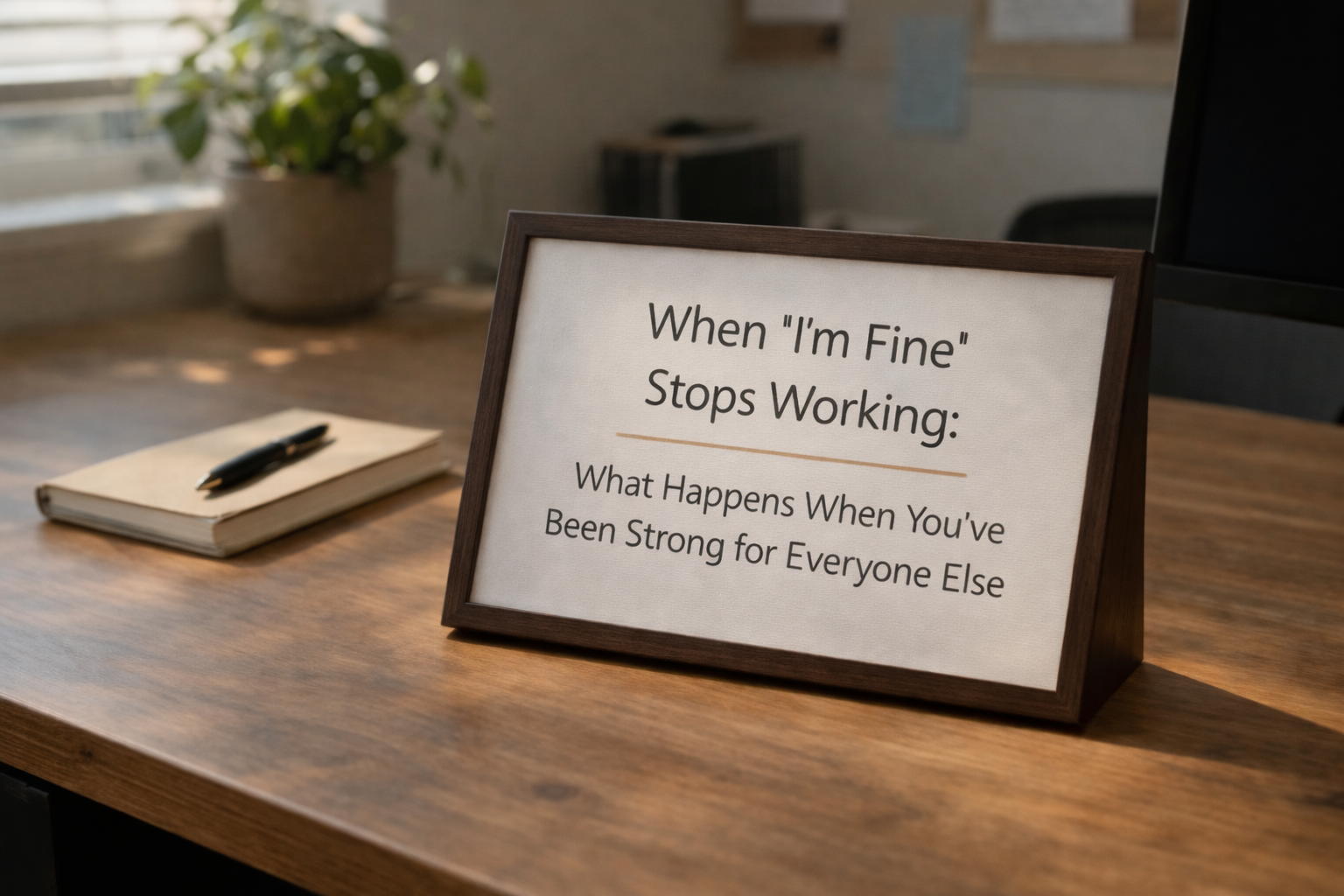
When “I’m Fine” Stops Working: What Happens When You’ve Been Strong for Everyone Else
You’ve been handling it. You always handle it. The job, the kids, the family group chat that somehow always ends up needing you to mediate, the appointments, the appointments for other people’s appointments. You’re the one people call when things fall apart, and you answer, because that’s what you do.
And then one day, something small happens. A comment. A long line at the grocery store. Someone asking you to do one more thing. And something in you just… doesn’t move. Or it snaps. Or you cry in the car and sit there longer than you meant to because you don’t want to go inside and be needed again yet.
That’s not weakness. That’s what it looks like when a person has been running on empty for a long time.
The Problem with “Strong”
There’s nothing wrong with being capable. But there’s a version of “strong” that becomes its own kind of trap. Today more than ever you are expected to carry more, ask for less, and keep going no matter what. You learn early that falling apart isn’t really an option, so you don’t. You compartmentalize. You push through. You tell yourself you’ll deal with it later.
Later rarely comes.
What comes instead is a body that’s exhausted in ways sleep doesn’t fix. A temper that’s shorter than it used to be. A growing sense of disconnection from things that used to matter. Relationships where you’re present but not really there. A flatness where feeling used to be.
Many people who come to therapy don’t describe their experience as trauma or burnout. They describe it as just how things are. They wonder if they’re broken or difficult or too much. They’ve spent so long managing everyone else’s emotional experience that they’ve genuinely lost track of their own.
What Emotional Dysregulation Actually Looks Like
When most people hear “emotional dysregulation,” they picture someone losing control, yelling, falling apart visibly. But emotional dysregulation often shows up much quieter than that.
It can look like shutting down completely when a conversation gets tense. It can look like anxiety that presents as irritability, so you snap at your partner and then feel terrible about it without knowing why it happened. It can look like going numb when you should feel something, or feeling a wave of something overwhelming when nothing dramatic has occurred. It can look like knowing what you need and being completely unable to ask for it.
For women who’ve spent years being the stable one, dysregulation often shows up as a kind of internal short-circuit. The system has been overloaded for so long that it starts misfiring. The reactions feel disproportionate to what’s happening in the present, because they are. They’re connected to everything that came before.
That’s not a character flaw. That’s a nervous system doing exactly what nervous systems do when they haven’t had room to process and recover.
Why This Isn’t Just Stress
Stress and unprocessed trauma can look similar from the outside, and sometimes they overlap. But there’s a meaningful difference between a period of difficulty you move through and experiences that get stuck in the body and keep influencing how you respond to the world, years later.
Trauma-informed therapy starts from the understanding that a lot of what people label as personality traits or personal failings are actually adaptations. The hypervigilance, the people-pleasing, the inability to rest, the bracing for things to go wrong. These patterns made sense at some point. They helped. The work isn’t about judging them. It’s about understanding where they came from and figuring out whether they’re still serving you, or whether they’re running the show in ways you didn’t choose.
That kind of work takes a therapist who can hold complexity, who understands that your life doesn’t exist in a vacuum, and who isn’t going to flatten your experience into a checklist.
What Therapy Can Actually Do Here
A lot of people come to therapy expecting to be told what to do, or to be handed tools, or to finally get a diagnosis that explains everything. Sometimes those things happen. But more often, what actually moves the needle is something harder to name: having a space where you don’t have to perform okayness, where someone is paying attention to what you’re not saying as much as what you are, and where the goal is to help you build a real relationship with your own internal experience, not just manage it better.
Approaches like EMDR, somatic work, and DBT-informed therapy are particularly useful for women dealing with this specific kind of exhaustion, because they work with the body and the nervous system, not just the thinking mind. They help people process what’s stuck, not just talk about it in circles.
Many people are surprised to find that after doing this kind of work, they don’t just feel less bad. They feel more like themselves. They have access to parts of their emotional range that had gone quiet. They stop dreading their own feelings.
The Thing Nobody Tells You About Asking for Help
Asking for support when you’ve been the support for everyone else is genuinely disorienting. It can feel like a betrayal of an identity you’ve built. It can feel like admitting something you’re not ready to name. It can feel like a luxury you haven’t earned yet, like you should be further gone before it counts as a real problem.
None of that is true, but it can feel very real.
What we’d want you to know is that the women who come to therapy when things are “just hard” tend to do some of the most meaningful work, because they still have enough left in them to engage with the process. You don’t have to be in crisis for this to be worth doing. You just have to be honest with yourself that something needs to change.
And the fact that you’re reading this? That’s a kind of honesty, even if you’re not sure yet what to do with it.
You Don’t Have to Keep Running on Empty
There is a version of your life where you’re not constantly bracing. Where relationships feel more mutual. Where you can feel your feelings without being hijacked by them. Where rest doesn’t come loaded with guilt. That’s not fantasy. It’s what happens when people get real support and actually use it.
Our team at Catalyst Counseling works with women across Maryland, Virginia, and DC who are dealing with exactly this kind of exhaustion, including women who’ve never thought of themselves as someone who “needs therapy” and who are still figuring out what they actually feel beneath all the managing.
We offer telehealth therapy only, which means you can work with a therapist from wherever you actually are, without adding another commute to your day. Evening appointments are available for those of you who are still handling everything from 9 to 5.
Ledrea Taylor, LCSW, is a therapist on our team who works with women, couples, veterans, and families dealing with trauma, anxiety, emotional dysregulation, and the kind of chronic stress that doesn’t have a clean name. She’s licensed in Maryland, Virginia, and DC, and she brings a trauma-informed, person-centered approach to her work. She currently has evening openings and is accepting new clients.
If any of what you read here resonated, you can learn more about Ledrea’s approach and background, or schedule a free 15-minute consultation to see if working with her might be a good fit. There’s no commitment involved in that first conversation. It’s just a chance to ask questions and see what feels possible. If any other therapists stand out to you please do not hesitate to ask about them!
If you’re not sure where to start, you’re also welcome to reach out to our team and we’ll help you figure out the right next step.