
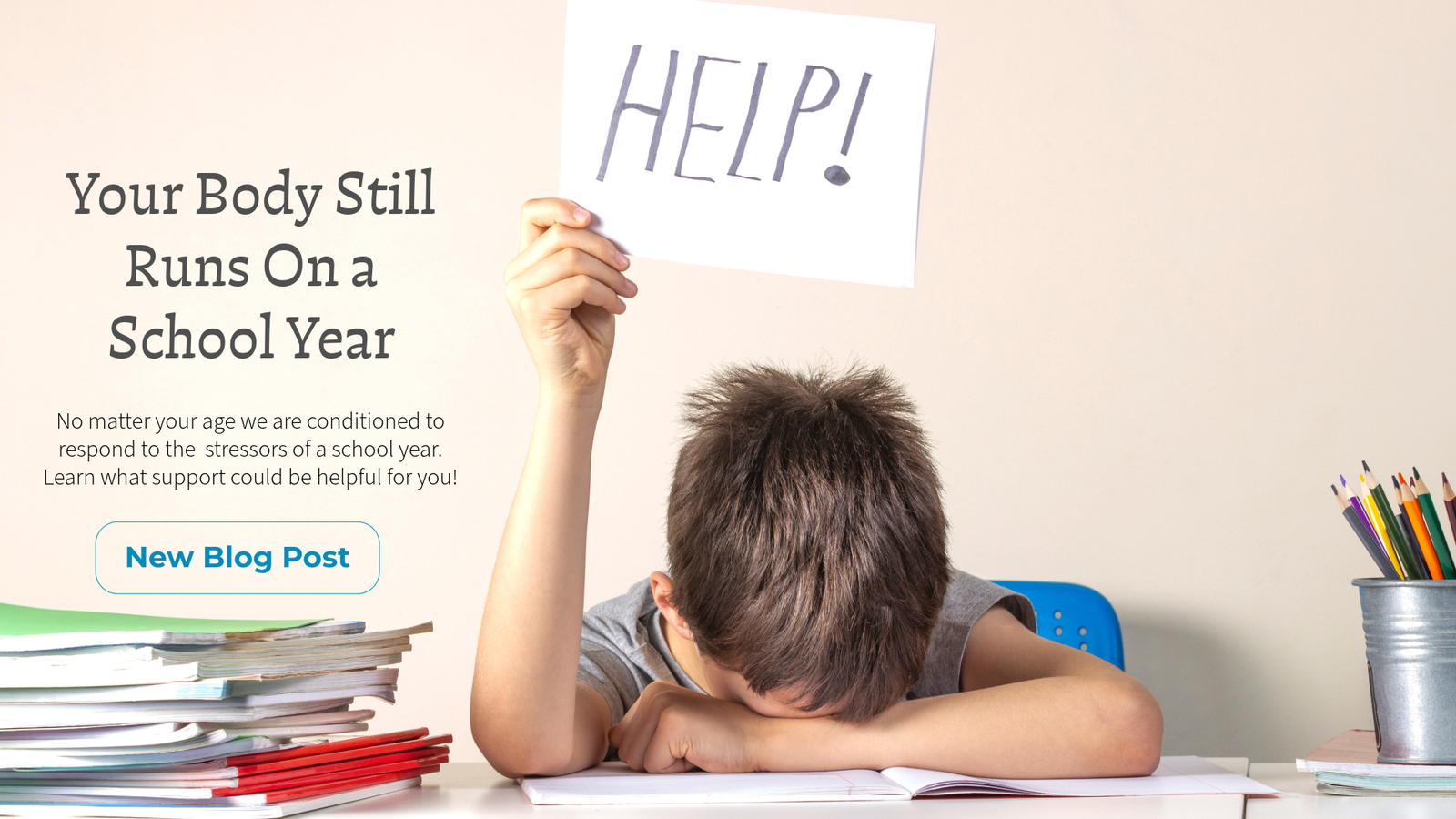
Every year around this time the internet fills up with advice for parents about their kids’ back-to-school anxiety. Watch for sleep changes. Validate the feelings. Start shifting bedtime a week or two early. It is good advice and most of it is what I would say too.
What almost nobody writes about is the adult holding the phone.
I have had the same conversation enough times now to stop treating it as a coincidence. Someone comes in during the first or second week of September, apologizes for taking up the slot, and says a version of the same thing: I can’t point to anything. Work is steady. Nothing has happened. I have just felt off for about two weeks, and it started somewhere around the third week of August.
Sometimes they are a parent and they assume it is the logistics. Sometimes they do not have kids at all, which they find more confusing, not less. Either way, the timing repeats year over year and usually has very little to do with the current year’s circumstances.
Late August is one of the densest sensory environments on the American calendar. The light angles differently in the late afternoon. The endcap at Target fills with folders and glue sticks. Traffic on 495 recovers its September personality around 7:15 in the morning. Buses reappear in lots you drive past without thinking about it. If you spent twelve or thirteen years of your life inside a school calendar, and most of us did, your body has a deeply rehearsed set of associations with all of that.
How a cue pulls up an old feeling
Memory is not stored as a clean, isolated file. It is stored with its surroundings attached. That is why walking into a particular kind of room can hand you a feeling before you have had a single conscious thought about it.
There is good experimental work on this. In a 2023 study of 180 participants, van Ast and colleagues confirmed the basic effect that recognition depends on context, and reported something more clinically interesting alongside it: contextual dependency is lower for emotional memories than for neutral ones. Neutral memories tend to stay tethered to where they were formed. Emotional ones travel.
That is the part worth sitting with, because it explains the strangeness of the experience. If emotional memories were tightly bound to their original context, you would only feel it walking into your actual childhood school. Instead a middle school hallway in Fairfax you have never once set foot in can do the job, because it is close enough. The feeling generalizes to rooms that merely resemble the first one.
There is a parallel literature on trauma anniversaries. Bruce and Weaver, testing cognitive models of anniversary reactions, found that these are real and measurable upticks in symptoms timed to a date, and that intrusive rumination is what predicted the reactions marked by stress rather than growth. The date sets things off. The rehearsing afterward is what keeps them running.
Put those two findings next to each other and late August stops looking mysterious. It is a date-anchored, sensory-rich, annually repeating cue set attached to a period of life when most people were forming their core opinions about whether they were capable, wanted, and safe.
Why school, specifically
For plenty of people school was fine. Boring in stretches, socially bruising in others, survivable.
For a lot of others it was where the hard thing happened, or where the hard thing at home became visible. School is where an undiagnosed learning difference gets read as laziness in front of an audience. It is where bullying happens on a schedule, in the same three locations, with adults nearby. It is where a kid who is managing chaos at home has to perform normal for seven hours and then go back.
None of that requires a capital-T catastrophe to leave a mark. What it requires is repetition, a body that had no way out of the room, and a set of conclusions the kid drew to make sense of it. You are slow. You are too much. There is a version of you who gets picked and a version who does not.
Those conclusions do not expire when you graduate. They go quiet, because adult life mostly does not resemble a school hallway. And then one week a year, everything resembles a school hallway.
How it shows up if you are not a parent
The parent version is the easiest to spot, so it is worth naming the others.
In high performers it usually looks like an unexplained early-fall slump. Output holds, because output always holds, but the internal experience shifts. More second-guessing on decisions that were easy in June. More rereading of emails before sending. A quiet, background sense of being behind that does not match any actual deadline. People almost always attribute this to Q3 or to a specific project, and then it happens again the following August during a completely different project.
In couples it tends to surface as irritability in the evenings, particularly between about seven and nine. One partner gets short, the other partner takes it personally, and neither of them connects it to the calendar. If your fights have a season, that is worth knowing.
In first responders the seasonal ramp is real on its own terms, and it stacks. Fall brings school-zone traffic, more calls involving kids, and shift changes that reshuffle sleep. For someone carrying older material, the operational ramp and the personal cue arrive in the same three weeks and it is very hard to tell them apart from the inside.
What actually helps
The first thing is naming it, which sounds soft and is not. There is a real difference between “something is wrong with me every fall” and “I have a cue-driven pattern with a start date.” The second one is a workable clinical problem. It has a season, an identifiable set of triggers, and a specific memory network underneath it. That is more than most people can bring in the door.
The second thing is watching the rumination, because that is the piece the anniversary research points at directly. The cue is going to fire. What determines whether that becomes two rough weeks is largely what you do in the hours afterward. Chewing on it, re-running old scenes, building a case about yourself, that is the part that extends the reaction.
The third is reprocessing the original memory rather than managing the annual symptom. This is where EMDR fits, and I want to be careful here rather than promotional. The meta-analytic evidence is more mixed than most practice websites admit. Rasines-Laudes and Serrano-Pintado’s 2023 review of 18 randomized trials found small effect sizes and flagged real risk of bias in the underlying studies, while also finding that therapist experience and the number and length of sessions meaningfully moderated outcomes. That is an honest picture, and it matches what we see clinically: EMDR is not magic, it works better in trained hands with adequate dosing, and when it lands, what changes is specific. The memory stops arriving with the whole package attached. The cue becomes just a cue.
August becomes a month again.
One question to sit with
If you are reading this on a Sunday night in late August and your chest is tighter than the week ahead deserves, here is the question I would sit with: is the thing I am bracing for actually scheduled for this week, or did it already happen a long time ago in a building I do not work in anymore?
If the honest answer is the second one, that is workable. Catalyst Counseling’s trauma-focused, EMDR-trained therapists work with adults across Maryland, DC, and Virginia on exactly this kind of pattern. You can schedule a consultation here.
References
van Ast, V. A., et al. (2023). Context reexposure to bolster contextual dependency of emotional episodic memory. Scientific Reports, 13, 17792. https://doi.org/10.1038/s41598-023-40982-0
Bruce, M. J., & Weaver, T. L. (2024). Testing Cognitive Models to Characterize Trauma Anniversary Reactions Marked by Stress and Growth. OMEGA – Journal of Death and Dying. https://doi.org/10.1177/00302228211066687
Rasines-Laudes, P., & Serrano-Pintado, I. (2023). Efficacy of EMDR in Post-Traumatic Stress Disorder: A Systematic Review and Meta-analysis of Randomized Clinical Trials. Psicothema, 35(4), 385-396. https://doi.org/10.7334/psicothema2022.309
This article is for general information and is not a substitute for individual clinical care.